
Cold Storage Near Me: Comparing Public vs. Private Warehouses
Finding reliable temperature-controlled storage sounds straightforward until you start comparing real options. Cold chain is unforgiving. A two-hour dock delay on a 95-degree afternoon can erase a month of careful planning. If you are typing cold storage near me and trying to decide between public and private warehouses, the right answer depends less on a generic best practice and more on your volume rhythm, handling needs, risk tolerance, and the real constraints in your market. In a city like San Antonio, TX, where refrigerated storage competes with heat, labor availability, and seasonal surges from produce and proteins, those details matter.
I have spent years on both sides of the fence: managing distribution in multi-client public cold storage facilities and helping shippers justify their own private boxes. There is no universal winner. There are only trade-offs. The best choice solves for your current reality and gives you room to grow without quietly taxing your margins.
What “public” and “private” actually mean in cold storage
Public cold storage facilities are multi-tenant warehouses that store inventory for many customers. You pay storage by pallet or cubic foot, plus handling and value-added services when needed. They run standardized processes, pooled labor, and shared equipment, all under strict temperature controls, usually across zones like frozen (around -10 to 0°F), chilled (typically 33 to 38°F), and sometimes ambient staging.
Private cold storage warehouses are owned or fully dedicated to a single company. It might be a facility you build or lease long term, or a dedicated site operated by a third-party exclusively for you. You control layout, software, staffing, and policies, and you carry the capital burden and operational accountability that come with that control.
From a distance, public facilities look like plug-and-play, while private looks like maximum control. Up close, the picture gets more nuanced. Public operators vary widely in service levels, slotting flexibility, and responsiveness. Private operations succeed or fail on management discipline, equipment uptime, and the realism of their labor model.
The cost conversation, uncluttered
In a public cold storage warehouse, you see a menu of fees: storage rates per pallet per month, in-and-out charges per pallet or case, cross-dock fees, case picking or repack rates, and premiums for off-hour work. The rate card is clear, although accessorials can add up if you have complex handling needs. Your cost is variable with your volume, which helps when demand swings.
Private facilities shift the profile. Capital expenditures and leasehold improvements land up front, then depreciate. You pay for refrigeration assets, racking, dock equipment, racking inspections, ammonia or CO2 system maintenance, energy, software, insurance, and labor, whether your building is full or half-empty. At steady, high utilization, your cost per pallet can beat public rates by meaningful margins. At uneven utilization, the numbers drift the other way.
A common blind spot involves energy. Cold storage electricity usage typically ranges from 25 to 60 kWh per square foot annually depending on insulation, set points, door cycles, and heat infiltration. At San Antonio TX rates that often span roughly 8 to 12 cents per kWh for commercial tiers, a mid-sized facility can see power bills in the tens of thousands per month. Public warehouses spread that cost across many clients, while a private operator must manage that variance week to week. Seasonal heat and dock dwell times move the needle more than most financial models admit.
Another blind spot is downtime. A compressor failure or failed evaporator fan on a summer Friday can force emergency service and product moves. Public facilities often have redundancy and maintenance on call, plus spare capacity in other rooms to reshuffle product. Private sites can build similar redundancy, but that adds cost that only pays off during the rare event.
In short, public costs are elastic and predictable, private costs are sensitive to volume and operational discipline. The right decision often hinges on whether you can forecast stable throughput and maintain high occupancy for most of the year.
Service levels and operational rhythm
Public cold storage facilities excel at smoothing daily variability. When a big retailer pulls a last-minute promo or a processor bumps production, the shared-labor model flexes better than a single-tenant team. Public operators have mastered mixed-SKU case picking, appointment juggling across carriers, and EDI connection with major grocery chains. Where they sometimes struggle is in prioritization for small-volume clients during peak weeks. If you represent 1 percent of a site’s revenue, you might feel it on a tight deadline.
Private warehouses give you priority by definition. You set the cutoffs, dock scheduling, and allocation of labor to order profiles. If your customers require stop-by-stop pallet building or strict lot rotation with customer-specific labels, you can bake it into your standard work. You also live with the constraints of your team size, your training pipeline, and your incentive structure. Handling accuracy in frozen rooms depends heavily on pick methods and lighting. A private operator must invest in scanning discipline and ergonomic tools for low-temperature environments, or error rates creep upward just when volumes spike.
In San Antonio, heat adds a layer. Dock to stock time matters because every minute that product sits on a warm dock eats into shelf life. Public facilities with sealed truck positions, vestibules, and disciplined dock door management have a measurable advantage over bare docks. Private operators can match that, but only if airflow, strip curtains, and dock door timing are taken seriously and audited often. When I see refrigerated storage in San Antonio TX underperform, it is usually because the facility underestimated dock heat loads and the staff let doors linger open longer than SOPs allow.
Compliance, traceability, and audits
Both public and private warehouses can meet FDA and USDA requirements, GFSI certifications like BRCGS or SQF, and customer-specific audit programs. The difference is the muscle memory. Large public cold storage operators run audits constantly. Their documentation, pest control logs, sanitation procedures, temperature mapping, and HACCP plans tend to be well rehearsed. If you are a smaller shipper with limited QA resources, tapping into that infrastructure has value that does not show up on a simple rate comparison.
Private operations can absolutely match it. The question is whether your QA lead and warehouse manager can keep SOPs current through staffing changes and during busy seasons. Recalls do not wait for a calm week. Whether you operate in a public or private site, insist on mock recalls every quarter and demand full lot-to-location-to-order traceability within minutes, not hours. If your WMS cannot produce that view, the facility is not ready.
Capacity and slotting flexibility
Public refrigerated storage networks often have multiple rooms at different set points. They can shift you temporarily from 35°F to 28°F if your product mix changes, or carve a small test area for a new line. They can also run short on space at the exact moment you need it, especially before holidays when protein and frozen categories flood the market. The phrase cold storage near me gains urgency when your carrier is staged at the gate and the warehouse reports a full house.
Private warehouses eliminate the “no room at the inn” moments, but you assume the forecast risk. If your launch misses, you are sitting on empty racks. If a major customer doubles orders, you scramble for overflow and pay spot rates at a public facility anyway, often at a premium. In practice, many private operators still keep relationships with public partners for seasonal overflow and emergencies. It is not an either-or world. It is a dial you adjust.
Technology and data access
Public cold storage facilities vary widely in technology maturity. The best-in-class run robust WMS platforms with RF scanning, directed putaway, temperature probes on MHE, and portals where you can view inventory, lot aging, and order status in near real time. Others rely on older systems with batch updates and limited integration options.
Private operations choose their own stack: WMS or ERP modules, yard management, and integration with carriers. The advantage is control. You can insist on serial capture, GS1 label compliance, and specific handling codes that match your QA program. The risk is underinvestment or slow upgrades. Cold chain data quality becomes an issue when sensors go uncalibrated or probing is inconsistent across shifts.
For brands selling into national grocers, ASN accuracy and on-time in-full performance matter more than the temperature in a single room. Both public and private setups can hit high marks. The path to getting there looks different. Public offers established rails, private offers customization that you keep cold storage warehouse san antonio tx tuning.
Risk management and insurance
Temperature-controlled storage adds risk categories beyond typical warehousing. Ammonia systems, CO2 systems, glycol lines, evaporators, and insulated panels all require specialized maintenance. Public operators live in this world and carry the appropriate insurance coverages, plus they maintain emergency response protocols familiar to local fire departments. They have documented plans for extended power loss, often with generator capacity sized to protect critical rooms.
If you go private, make sure your insurer understands your refrigeration design and your contingency plan, not just a generic property schedule. Don’t overlook simple, high-impact practices: door interlocks, automatic closers, feverish attention to icing around thresholds, and weekly checks on gasket integrity. Product loss from frost build-up causing door misalignment is more common than people admit. The best private operators log minor anomalies and fix them quickly instead of letting them become habits.
Labor in low temperatures
People do not work at their best in a 0°F environment without thoughtful scheduling and gear. Public facilities generally have established rotation patterns, heated break rooms near frozen zones, and PPE standards that keep productivity steady. They also carry larger pools of trained lift drivers, making it easier to backfill when someone calls in sick.
Private sites can match that with intent. Budget for premium cold gear, heat recovery in break spaces, and incentive pay tied to accuracy, not just speed. If your pickers bounce between chilled and frozen areas, plan the sequencing so body temperatures do not swing wildly. Minor details, like staging labels inside the door of the frozen room to shorten dwell times, have outsized impact on both accuracy and comfort.
When public cold storage fits best
If your volumes are seasonal, your SKU count is modest, and you need refrigerated storage across multiple regions, public facilities make sense. You gain scalability and speed to market. For a growing San Antonio brand, a public cold storage warehouse near me lets you prove demand before committing capital. It also spreads risk across multiple customers. Should one product line pause, the operator backfills space with another client and your rate card stays the same.
Public is also a strong choice if you require specialized handling that many operators already offer: USDA inspection rooms, export documentation, labeling for major retailers, or date code management matched to strict first-expired-first-out rules. The larger public operators have seen your scenario before and have SOPs ready.
Where public can disappoint is in soft priorities. If your load needs to cut in front of three others at 5 p.m., you need a relationship, not just a contract. Choose operators with onsite leadership empowered to make those calls, and give them forecasting visibility to earn that flexibility.
When a private or dedicated warehouse wins
Private cold storage shines when you have consistent, high-volume throughput and specialized workflows that would incur endless accessorials in a public setting. If your operation requires custom palletization, heavy kitting, or daily micro-allocations to dozens of routes, those touches are cheaper and cleaner in your own four walls. You decide the slotting logic, label formats, carton sizes, and the exact walk paths inside the freezer.
In San Antonio TX, where land and power are still relatively accessible compared with coastal markets, a private build can pencil out for mid-market shippers sooner than it would in denser cities. A 100,000-square-foot temperature-controlled storage site, divided into multiple rooms, can support a regional distribution model that reduces line-haul costs and puts you within a day’s drive of major Texas metros. The savings compound if you also bring in processing or light packaging under the same roof, shaving touches and dwell.
The risk is utilization. If you are not confident in your base load, consider a hybrid: a dedicated suite inside a larger public facility. You get control over a room with your own racking, lock control, and SOPs, while the operator provides dock services, security, and maintenance. It is often the most practical bridge between pure public and fully private.
A practical path to deciding
You do not need a perfect forecast to choose a direction. You need a bounded decision that you can revisit with data. I recommend building two financial models for the next 18 months: one assuming you stay in public cold storage facilities, another for a private or dedicated option. Use realistic assumptions about shrink, labor, accessorials, and energy. Do not bury line items. Then, score operational risks as a simple heat map: dock congestion, appointment compliance, audit readiness, overflow availability, and technology fit.
Here is a compact field checklist that helps during site visits and operator interviews.
- Time dock-to-chill or dock-to-freeze on two random inbound loads and note door open times.
- Ask to see the last temperature mapping study and alarm logs, including response times.
- Walk the pick path in frozen with a stopwatch, then compare with chilled. Look for label staging, scanner usability, and replenishment discipline.
- Review mock recall documentation, then request a live trace from lot to outbound BOL while you watch.
- Confirm overflow plans for peak weeks and how your loads will be prioritized compared with larger accounts.
If you are focused on cold storage San Antonio TX specifically, add a question about July and August power strategies. Some facilities pre-cool rooms ahead of peak heat hours, shift defrost cycles, or run demand response programs. Those tactics affect temperature stability during the hottest parts of the day, especially around busy docks. Good operators will explain their playbook without handwaving.
The “near me” factor and transportation reality
Proximity is not just about miles. A cold storage warehouse near me might be 8 miles away but require a right turn across two lanes of highway at rush hour that adds 25 minutes every trip. Visit at the times your trucks will actually arrive. Check whether the facility has true drop-trailer capability and yard organization or relies on live loads only. If your carriers fight for appointments and your tender acceptance drops, the proximity advantage evaporates.
San Antonio’s geography offers benefits for southbound and northbound freight. If you ship cross-border, ask the warehouse about bilingual staff, bond capabilities, and experience with maquiladora flows. If your refrigerated storage San Antonio TX provider can coordinate with LTL and pool distribution, you can consolidate outbound loads and stabilize delivery windows across Texas and neighboring states. That kind of network fit often outweighs a small rate difference.
Cold chain edge cases that tip the scales
Reality rarely matches plan. Count on a few edge cases and decide now which model handles them better.
- Retailer rejects: When a retailer rejects a chilled load for temperature variances, public facilities typically have faster rework capacity, inspectors on call, and backup room space to triage. Private sites can do it too, but you need spare labor that day.
- Rapid relabel: Date code or allergen label mistakes require immediate relabeling. Public sites with established rework areas and printers staged in cold zones move quicker.
- New product pilots: If marketing wants to test a 20-store rollout with special displays inside a 35°F room, public facilities with light assembly services already honed can save weeks.
- Emergency moves: A private site with one freezer condensing unit offline needs friends. If you do not already have a public cold storage partner, you are negotiating at the worst possible moment.
- Surge beyond carrier capacity: During holiday peaks, public sites usually have more dock doors and drop-trailer depth, which eases linehaul spikes.
None of these scenarios decide the whole case, but they should inform your weighting.
Negotiating with public facilities without creating friction
Public operators like predictable clients. You will get better service if you make their planning easier. Share a rolling 8-week forecast. Book recurring appointments for your heaviest lanes. Keep your ASN and labeling consistent, and you can often trade that reliability for better rates or priority access to limited freezer slots. A fair contract protects you from surprise accessorials but gives the operator enough margin to staff your cut times. If you try to squeeze every penny, expect to wait behind customers who left some pennies on the table.
Ask for simple performance metrics: on-time load completion by requested cut time, case pick accuracy by lot, and average time from gate-in to dock-to-chill. If they can show stable history for other clients, your risk drops.
Building a private site with pragmatism
If you lean private, resist the temptation to overbuild in year one. A smaller, well-insulated box with efficient circulation patterns beats a large echoing space that never reaches steady-state occupancy. Plan for modular growth using demountable insulated panels. Install more electrical capacity than you need now, and leave space for another compressor skid. Choose racking that supports both selective and push-back configurations so you can pivot between higher picks per hour and deeper storage as your SKU mix evolves.
For temperature-controlled storage San Antonio TX, over-invest in dock insulation and airflow management. The heat load at the dock outsizes the math you will see on paper. Prove your dock-to-chill cycle time in summer before celebrating winter performance. Build a cadence for defrost cycles that avoids overlapping with peak inbound windows. These discipline points determine whether your product leaves the building with the same quality it had at receipt.
Hybrid strategies that often win
Many companies blend options. They anchor their core volume in a private or dedicated room, then push overflow to public cold storage facilities during peaks. They keep value-added services like relabeling or kitting in the public site that runs it efficiently, while they run straightforward pallet-in/pallet-out in the private building. Or they choose a single public operator with a campus in San Antonio and another in DFW or Houston to reduce transfer miles, while reserving the right to open a private annex later.
The hybrid approach turns the “public vs. private” debate into a sequence. Start with public to validate demand and learn your true handling profile. Move to a dedicated suite once you can forecast base load with confidence. Build private when the math favors it and you have leaders ready to run a cold site with daily rigor.
Where to start if you need cold storage near me right now
If you need refrigerated storage this quarter, do three quick things. First, map your average daily pallets in, pallets out, and the percentage of case picks versus full pallets. This ratio predicts your handling cost more than any other statistic. Second, list your top five retail or foodservice requirements, with penalties attached. Compliance costs dwarf small rate differences. Third, build a simple scorecard for candidate sites within a realistic drive. Tour them during their busy hours, not mid-morning on a quiet Wednesday.
San Antonio has credible options, from large multi-client cold storage warehouses to specialized temperature-controlled storage rooms attached to processors. Availability moves with seasons. If a facility sounds perfect but cannot confirm dock times you need for the next two months, it is not your perfect match. It is better to secure reliable service at slightly higher rates than to chase an ideal rate into constant rescheduling.
Final thought, grounded in practice
Cold chain decisions reward humility. Expect variability. Resist assumptions that a single model will serve you for five years without adjustment. Public cold storage gives you flexibility and learned process at a known price per touch. Private cold storage gives you control and long-term cost leverage if you can keep the box full and disciplined. In a market like San Antonio TX, where heat, growth, and logistics all push and pull, the strongest operators do not ask “Which is better?” They ask “Which mix works for my next 12 to 24 months, and how do I keep optionality open?”
If the phrase cold storage warehouse near me sits in your search bar, the right answer sits in your flows, not your preferences. Measure them honestly, visit with a critical eye, and choose what keeps product safe and customers satisfied when the dock is slammed and the thermometer reads triple digits. That is the day your decision will prove itself.
Business Name: Auge Co. Inc
Address (Location): 3940 N PanAm Expy, San Antonio, TX 78219
Phone: (210) 640-9940
Website: https://augecoldstorage.com/
Email: info@augecoldstorage.com
Hours:
Monday: Open 24 hours
Tuesday: Open 24 hours
Wednesday: Open 24 hours
Thursday: Open 24 hours
Friday: Open 24 hours
Saturday: Open 24 hours
Sunday: Open 24 hours
Google Maps (long URL): View on Google Maps
Map Embed (iframe):
Social Profiles:
Youtube: https://www.youtube.com/channel/UCuYxzzyL1gBXzAjV6nwepuw/about
AI Share Links
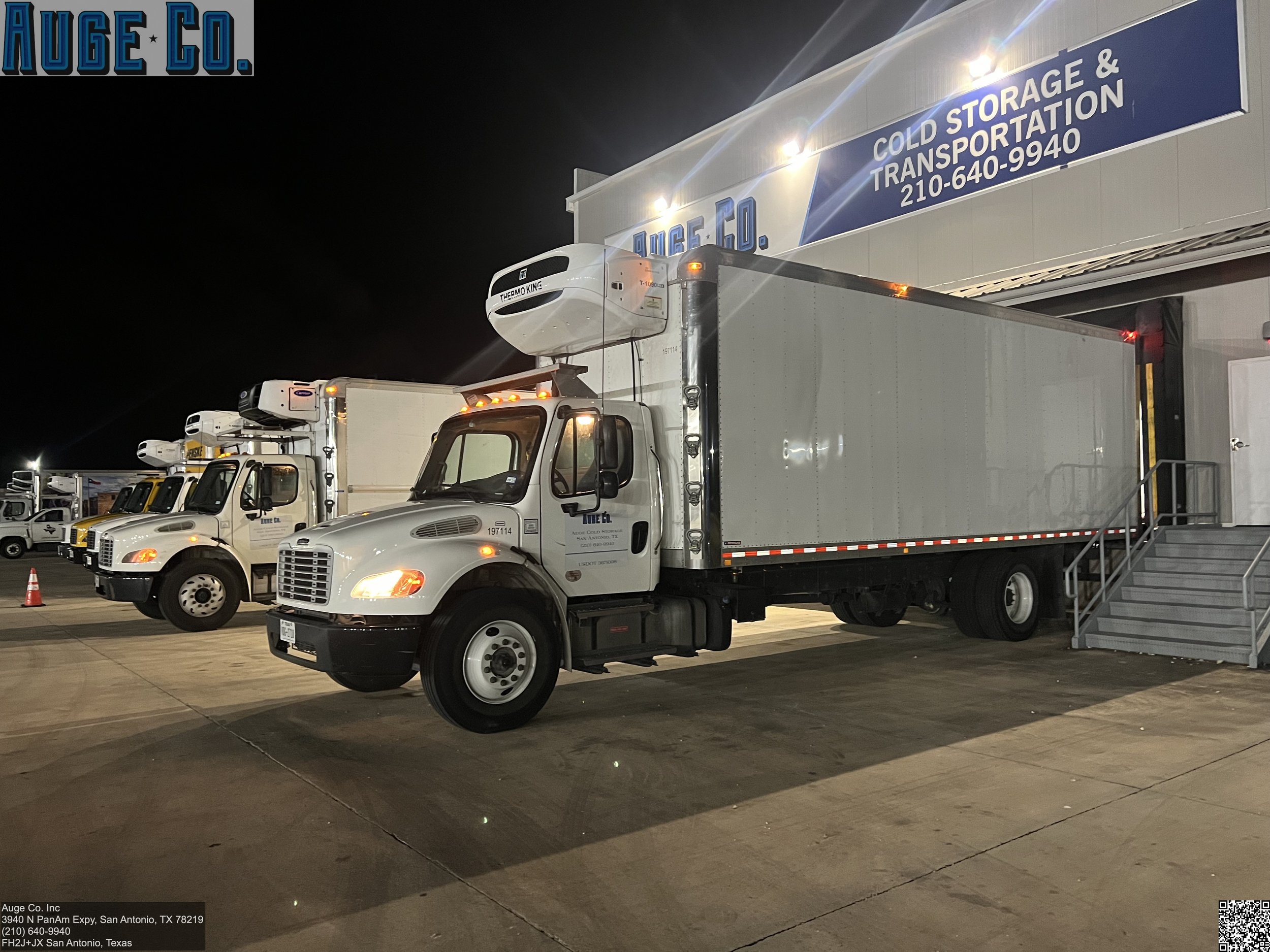
Auge Co. Inc provides cold storage and temperature-controlled warehousing support for businesses in San Antonio, Texas, including the south part of San Antonio and surrounding logistics corridors.
Auge Co. Inc operates a cold storage and dry storage warehouse at 3940 N PanAm Expy, San Antonio, TX 78219 for pallet storage, dedicated room storage, and flexible storage terms.
Auge Co. Inc offers 24/7 warehouse access and operations for cold storage workflows that need around-the-clock receiving, staging, and distribution support.
Auge Co. Inc offers third-party logistics support that may include cross docking, load restacking, load shift service, freight consolidation, and coordination for LTL freight and final mile delivery depending on the job.
Auge Co. Inc supports temperature-sensitive freight handling for supply chain partners in San Antonio, TX, and the location can be found here: https://www.google.com/maps/search/?api=1&query=Google&query_place_id=ChIJHc6Uvz_0XIYReKYFtFHsLCU
Auge Co. Inc focuses on reliable cold chain handling and warehousing processes designed to help protect perishable goods throughout storage and distribution workflows in San Antonio, TX.
2) People Also Ask
Popular Questions About Auge Co. Inc
What services does Auge Co. Inc provide?
Auge Co. Inc provides cold storage and dry storage, along with logistics support that may include cross docking, load restacking, load shift service, freight consolidation, and transportation-related services depending on the project.
Where is the 3940 N PanAm Expy location?
This Auge Co. Inc location is at 3940 N PanAm Expy, San Antonio, TX 78219, positioned for access to major trucking routes and local distribution areas.
Do they offer 24/7 cold storage operations?
Yes. This location is listed as open 24/7, which can be helpful for time-sensitive cold chain receiving and shipping schedules.
Does Auge Co. Inc offer pallet-based cold storage?
Auge Co. Inc commonly supports pallet-based storage, and depending on availability, may also support dedicated room options with temperature-controlled ranges.
What industries typically use cold storage in San Antonio?
Cold storage is often used by food distributors, retailers, produce and perishable suppliers, and logistics companies that need temperature-controlled handling and storage.
How does pricing for cold storage usually work?
Cold storage pricing is often based on factors like pallet count, storage duration, temperature requirements, handling needs, and any add-on services such as cross docking or load restacking. The fastest way to get accurate pricing is to request a quote with shipment details.
Do they provide transportation or delivery support?
Auge Co. Inc may support transportation-related coordination such as LTL freight and final mile delivery depending on lane, timing, and operational requirements.
How do I contact Auge Co. Inc?
Call [Not listed – please confirm] to reach Auge Co. Inc. Website: https://augecoldstorage.com/ Email: [Not listed – please confirm] Social profiles: [Not listed – please confirm]
Landmarks Near South San Antonio, TX
Serving the South San Antonio, TX area with cold storage for perishable goods and distribution schedules – just minutes from Mission San José.